
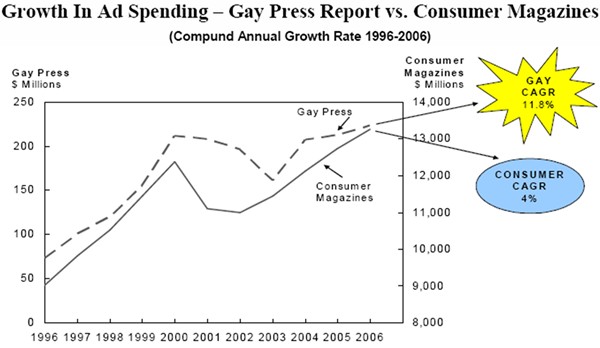
Gays and lesbians are far more affluent as a group than their hetero counterparts.
That’s been an accepted marketing mantra for decades. I know. When I worked for a gay newspaper in the 1990s we used various “research” reports that gave the numbers. Even then I puzzled about how these research marketing firms got their numbers.
Now a new report is challenging that myth by trying to make the case that lesbians and gay men (lesbians in particular) are actually more likely to be living in poverty than straights. I think they’re straining a bit with the admittedly limited available data, but first some background.
Joining upwards a million other queers in 1993, Michael and I maxed out our credit line to attend the March on Washington for Lesbian, Gay, and Bi Equal Rights and Liberation, held in Washington DC. We pooled our resources with six other gay guys and rented a van for the trip.

One could go nowhere without running into cute guys and gals with their clipboards, wanting to demograph us. These folks were also at local Pride events a couple of years later, and while we’ve never been on a ship, it’s a pretty safe bet that those who have gone on a gay cruise also filled out a demographic questionnaire seeking to define the “gay market”.
No wonder the results indicated an affluent market. Little about these surveys was scientific. They were selectively targeted toward upwardly mobile guppies on vacation and the results showed that.
Somewhere along the line this “gay market” came to define the “gay community” as a bunch of sophisticated globe trotters who drink only expensive, name brand liquors and wear designer clothing and fine jewelry. We also fuck like rabbits, but that wasn’t really a big selling point and was rarely asked until the CDC entered the survey game later on.
Truth is, me and many other regular Joe homos have long suffered an inqueeriority complex because we have never been able to keep up with our peers economically. The biggest advantage that gays and lesbians have–as a group–is that fewer of us raise children. That’s a really huge advantage when it comes to disposable income, which matters a lot to marketers.
Wikipedia, the premier authoritative Internet source for all knowledge and information on all topics* continues to trumpet this selective data today: “The LGBT market comprises a large and influential group of customers to a broad range of companies, across industry segments, across many countries around the globe. In the U.S. alone, the LGBT market is estimated to be worth $660 billion (2006) in disposable income.” (link)
So, what’s up with this recent Washington Blade headline:

Gay newspapers, like the Blade have depended on the market research I just described to sell advertising to big name companies like Ford, Ikea and American Express. Now we’re being told that we’re poorer than everyone else.
What does this latest insight into the lesbian and gay world from The Williams Institute at the UCLA School of Law, actually say and not say?

- Data used by Williams Institute
For one thing I read nothing in the report to justify the Blade headline. True, there is a single finding that there is higher percentage of lesbian couples living in poverty than their heterosexual counterparts. But wait, that information is based on U.S. Census data of “same sex female” households. Census data on gay and lesbian couples has yet to be proven to be a reliably accurate measure of gay or lesbian anything.
Of the two other sources used, the National Survey of Family Growth and the California Health Interview Survey, the results are mixed and therefore cancel each other out.
The report goes to some lengths to break the data down further to make a plausible argument that lesbians may actually be poorer than heterosexual women, but only if one accepts the researcher’s claim that they understand poverty enough to wield the “controls for different family characteristics”. “After adjusting for the range of characteristics that predict poverty, gay and lesbian couples are significantly more likely to be poor than their heterosexual counterparts.”
The differences in some of the samples is negligible and I saw no reported margin of error. The difference between 22.2% (same sex female low income families) and 20.9% (heterosexual low income families) is pretty slim. Given there was only 14.2% same sex male low income families would suggest the differences are due to gender inequities more than sexual orientation.
There is simple not a good basis for the statement that “Lesbian, Gay and Bisexual Americans More Likely to Be Poor Than Heterosexuals”, as stated on the press release from the Williams Institute. In all probability gays and lesbians are part of every economic stratum, and I see that reflected in the data above. There’s nothing inherently wrong with “target marketing” us as a group, but let’s be real about who we are.
The Williams Institute, to its credit does that when it says: “The myth of gay and lesbian affluence is just that–a myth”, and “more attention to sexual orientation in data collection would vastly improve out knowledge and understanding of poverty in the LGB community.
* (snark)
Some more cool gay (white) marketing pix:





~


